Showing posts with label memory. Show all posts

Monday, June 17, 2019

The Lost Country

In Star Trek, the future is the Undiscovered Country. The future is the Lost Country for people with memory or cognitive difficulties.


My father moved to the lost country. The arduous journey was slow and filled with anguish, especially for my mother. For the first five years, I wasn't sure he was going anywhere. He and Mom sniped at each other about what they had heard on the evening news. We assumed he didn't understand the commentary because he refused to wear his hearing aids. He made mistakes playing his favorite card game. We thought it was because he wouldn't wear his glasses. He stopped calling us by name, and my brother and I compared notes. He told the same story over and over like a pre-recorded loop, and his friends began to avoid him. He stopped using the telephone. He drove to the coffee shop every day like he had a job and had to get to it. He stopped recognizing people and could no longer differentiate between past and present. He would become obsessed with a memory from his youth or childhood and talk about it exclusively, endlessly. He failed the mental cognizance tests at the doctor's office.


He sold his beloved Watusi cattle and got ripped on the price because he couldn't remember which animals were Foundation Pure, 15/16ths or some other lesser cross. What a sad change for a man who loved his cattle as much as his family. When my brother was born, he had told Mom the baby was "as pretty as a newborn calf." A rich compliment from him.


He adopted methods to cope with failing memory. If someone came to visit, he didn't have much to say, but what he did say made perfect sense. "Good to see you." "Glad you dropped by." "Come back again sometime." If he contributed to the conversation at all, it was in the context of an old memory.

When it became obvious he wasn't the same man he used to be, Mom gave me a clipping to read:


   'Don't try to make me understand. Let me rest and know you're with me. Kiss my cheek and hold my hand. I'm confused beyond your concept. I am sad and sick and lost. All I know is that I need you to be with me at all cost. Do not lose your patience with me. Do not scold or curse or cry. I can't help the way I'm acting, can't be different though I try. Just remember that I need you, that the best of me is gone. Please don't fail to stand beside me, love me til my life is done.' Author Unknown

He became belligerent and couldn't be reasoned with. He ridiculed us for saying he shouldn't drive in a blizzard. He didn't notice that his clothes were dirty or foul smelling and refused to bathe. He became incontinent. He declared he was perfectly content with the situation. We were the ones with the problem.

He didn't take that journey alone. My mother was right beside him. She treated him kindly and gently. She kept him presentable. At the proper time, she took the car keys away from him. If he wanted to go drink coffee, she took him. She did everything in her power to maintain a semblance of normalcy and routine. She gave him little chores to do, like setting the table or taking out the trash, and stopped expecting him to be able to mow the grass or change the oil.


With her own strength rapidly fading, my mother made the heart-wrenching decision to move him to long-term care. He adapted well to the new country where they allowed him to wear his cowboy boots and listen to Johnny Cash on Alexa. He thought he was in a hotel with a great restaurant. He was never able to find his room by himself. He watched Lawrence Welk on TV but didn't know how to change the channel. Someone had to remind him to use the toilet. He was easy to get along with.

In the dining room, he hesitated to eat the food placed before him, because he knew he didn't have cash on him. If someone sat with him and said the restaurant was running a tab, he ate with gusto. He always offered his food to someone else if he noticed they weren't eating. He observed that the restaurant catered to the elderly. In fact, he became more talkative and occasionally knew my name.  

Mom spent every day with him. Since she didn't drive after dark, they had a daily argument when she left. He wanted to go with her. When she pointed out that she wasn't able to care for him any longer, he reasonably suggested that she stay there and he would go home. The nursing staff finally asked her to stop telling him when she was leaving.  

I expected the end of the journey to last longer. Two and a half months after entering long-term care, he died of a massive stroke. The personality, mannerisms, and wit of the man I called Dad died years earlier.

NOTE:  If someone in your family can't remember what year it is, the name of the President, what they ate for breakfast, stops liking their favorite activities, or exhibits any of the behavior above, I urge you to seek medical help for them.   https://alz.org/

Monday, May 27, 2019

The Buick

Until we decided we needed a used 1986 Ford Econoline custom van to haul our kids, their stuff and their friends, we drove a 1978 Buick Regal. It was one of the first autos with plush fabric seats. We were skeptical about the interior but the salesman said research indicated the upholstery would outlast the car.  He was right, too.

Besides the cushy interior, it had cruise control, a button inside the glove box to pop the trunk open, bucket seats, and a sunroof; all the amenities available in 1978. And it was fast too. We loved it.

One day we were in town and decided to run the Buick through the car wash. About half-way through the cycle, the sunroof sprung a leak. On my side of the car. While my husband quickly checked that it was indeed closed all the way, I scrambled to crawl over the console into the back seat. My gallant husband insisted that I stay where I was so the upholstery wouldn't get wet. 

What a guy. 

He wouldn't leave the car wash with the soap still on the car on, so water continued to drip around the seal. By the time the rinse cycle finished, I was thoroughly soaked, but the seat wasn't getting too much water on it.

We pulled out of the automated car wash and drove directly to the Buick dealership with both of us fuming, but I'm sure for different reasons. I was mad that I was wet and couldn't finish the errands we had come to town to do. My husband was ticked off that his pride and joy had malfunctioned. At the dealership we parked at the curb, and I jumped out and beat my husband to the door.

The salesman met me in the middle of the showroom floor. Before I could utter any of the complaints I had mentally rehearsed, he said, "I thought you were supposed to take your bra off for a wet t-shirt contest."

That remark released the pressure valve on the pent-up steam in my system. My husband was close enough behind me to hear the quip. He and several other employees, the owners and a couple of customers howled with laughter while I bit my lip and tried not to say any words that might make their way back to my grandmother. I threatened to kick the guy who suggested I go ahead and take it off, shirt too.

The fix was an easy one. If we hadn't been trapped inside the car wash, we probably would have figured it out. A drain tube from the sunroof had plugged.

The Regal figured in many notable occasions at our house. My son and one of his friends used it for their science fair experiment. If you attach a small propeller to the lead on a voltmeter, you can use said voltmeter as a wind speed indicator once it is calibrated. The boys took turns standing in the open sun roof holding the propeller while I drove various speeds and the other noted the voltage and speed. They received a blue ribbon for that project.

One summer we decided the farm work was caught up enough for us to take a weekend off and go to Wichita for our wedding anniversary. The car was still in great shape because we took good care of it. We packed an overnight bag and jumped in the Buick. We had driven about five miles, chatting about needing a break from round the clock farm work when my husband asked me a question.

"When's the last time you checked the oil on this car?"

I had a lot of jobs besides helping on the farm by driving the tractor, pulling tanks of fertilizer to the field, keeping the records, and driving the grain trucks during harvest time, such as growing a huge garden, canning the excess, raising children, sewing their clothes and ours. This was during the days when the Women's Libbers got in your face and demanded you join their movement. With all the responsibility I already had, my pat answer was always, "If I got any more liberated, I'd have to change the oil on the tractor." Looking under the hood whether it be a car, pickup truck or tractor was something the guys did.

So I said: "There'd have to be a first time before there could be a last time."

He braked to a stop and opened the hood. There was no oil on the dipstick. So, how long had it been since HE checked the oil?

If cell phones had been invented, he would have called his brother to bring a couple of quarts of motor oil. Instead, we drove back home with him complaining about how irresponsible I was while I indignantly pointed out that I had NEVER once been asked to check the oil on ANYTHING. It. Wasn't. My. Job.

Once home, he said not to drive the car until he got a chance to change the oil. He put on his work clothes and went back to the field in his pickup. I unpacked and sulked. I thought then and still do today that it was a clear cut case of Universal Rule # 1: The woman is always right. Enough said?

Monday, April 22, 2019

Nothing ever happens at my house.


I've lived in the same sparsely populated rural neighborhood for over 40 years. Depending on whether you go up the road or down the road, it is five miles to the next farmhouse. Neither of those two families have any reason to drive past my house. About the only people besides the mail lady who use our road are other farmers checking on a field in the vicinity. I see as many tractors as I do pickup trucks. An abandoned farmstead lies approximately one and a half miles southeast from my house as the crow flies. The owners moved away about 20 years ago. It is surrounded by trees and apparently very inviting to dopers who want to get out of the weather while they cook their meth.

The first time I heard that it had been raided (about eighteen years ago) was in the context of a local character who thought the Feds were after him for drinking and driving. When he saw a string of official looking cars bearing down on him, he had visions of being incarcerated for open container, driving under the influence, possibly expired tags and no drivers' license. He was just a good ol' boy taking a leisurely Sunday morning drive while he drank a six-pack of Bud. The guys in the white space suits (bio-hazard personal protective clothing) paid no attention as he threw his beer in the ditch and scrambled for some chewing gum to disguise his breath. 

We heard that the woodwork of the old house was permeated with highly flammable residue from the illegal meth kitchen. Curious neighbors were warned to stay away. Don't light a match!

 A different neighbor who lived off thataway discovered evidence of an outdoor meth lab in his pasture.

In the meantime, crystal meth labs punctuated the evening news. Over-the-counter cold and diet medications containing Ephedrine or Pseudoephedrine were ordered to be kept under lock and key the same as prescription drugs. Clerks at convenience stores received instructions to never sell more than 2 packets to a customer and to keep an eye out for strings of customers coming in to purchase the same product. Especially if they had rotted teeth.

During the same time frame, two counties north of me, hard-to-track mobile meth labs climbed to the top of the national statistical charts. Law abiding folks in the area were looking askance at vans with Barton County plates.

Nearly two years passed from the first time we heard about the meth house in the neighborhood. One evening we answered the phone and it was the sheriff telling us not to open the door to strangers. Law enforcement had raided the house again and a suspect took off on foot. The first thing we did was turn on all outdoor and perimeter lights and turn off all indoor lights. We wanted to be able to see out while no one else could see in. When the coon dogs started barking our daughter freaked out.

We called the sheriff back and he sent a deputy who was there within minutes. He and my husband, both armed, investigated the garage, chicken house and other outbuildings. Finding nothing suspicious, they decided our dogs could probably hear or smell the activity taking place at the raid. A pair of dogs had been brought in to track the suspect. Unfortunately, they lost the scent after a few hundred yards. My husband told them anyone who has ever been coon hunting would know the dogs are useless as soon as the temperature hits dew point.

In the meantime, they were waiting for the airplane with infrared detection equipment. When it arrived we could hear it for hours as it searched the area for the escapee. Eventually, we learned that the suspect was apprehended the next day. He had run twelve miles to town. What good practice for a half marathon.

Life settled down. Every once in a while we noticed a vehicle, a white van, stopped in the road south of our house. Maybe it belonged to a land owner. Maybe our road had turned into lovers' lane. Whoever was in it, they weren't bothering us. One day my husband noticed the plain vanilla van had Barton County plates. Recalling the news about all the mobile meth labs, he called in a report to our county sheriff's office.

The next day all the deputies were laughing about the suspicious van. We weren't the butt of the jokes though. Another agency in Barton County drives unmarked vehicles. This outfit sent an agent to keep an eye on the meth house, but he was to remain inconspicuous. Our sheriff was riled that the KBI was conducting a covert operation in his county. He was amused that a local citizen had turned them in for suspicious behavior.

No, nothing ever happens at my house.

Monday, April 15, 2019

Daddy Was Watching Her

My daughter loves cats. She has since she was a toddler.

Honestly, I don't remember how this story starts. My minds' eye doesn't see what I was doing or where her older brother was. He is strangely absent. This particular memory starts and ends with my husband 'keeping an eye on' our daughter while I did something in the house.

About twenty minutes into his voluntary duties, my mom 6th sense told me to go look in the garage and see how he and the three-year-old were doing. They were still alive. He was fiddling with something mechanical and she was sitting on the floor against the wall singing. On the garage floor, where it wouldn't have surprised me to see spiders. The garage floor, which truly wasn't clean enough to sit on. The garage floor, where I saw something that definitely didn't belong.

"Hey! I thought you said you'd watch her."  I whisper/hissed at him.

"Everything's fine," he insisted. "She's just sitting there singing to the kittens."

"Yeah, you're right. She's singing to them." I grabbed his arm and forced his full attention toward his adorable daughter. "Did you not notice that she has broken the necks of all four of them?"

I went over to her and gently removed a limp body from her tight little fists and placed it with the other three unfortunate kittens.

She had made up a lullaby to sing to her kitties. Since they needed to be rocked to sleep while she sang, she had taken them one at a time in a death grip about the neck and swung them back and forth.

How do you explain to a three-year-old that the kitties aren't going to wake up and play?

We took the kittens and a shovel into the trees and had a solemn cat funeral. We had a lesson about stroking kitties and not squeezing them so hard. We talked about never picking an animal up by the neck.

I would have been mad at my husband, but I have to confess that once when I thought she and her brother were playing nicely together in the yard, the mayhem led to my daughter getting eleven stitches.

Parenting is a learn as you go process. What a lot there was to learn.

Like the time I told the eye doctor my son didn't need shatterproof lenses.

Monday, February 25, 2019

Help! I've locked the car and my wife is inside.


One cold February day my husband picked me up for lunch and we drove down the street to Woody's for a hamburger. As soon as he shut the door on his pickup, he knew he had locked the keys inside. In the old days one would have asked around for a coat hanger or flyswatter handle to bend into a hook, force past the top of the window and fish for the knob on the lock post. We called the locksmith who said his helper could be there in fifteen minutes.

We ordered our food. Before we were done eating, the assistant came in the restaurant with Ed's keys and pointed out the obvious. The pickup was unlocked. However, he had a problem. The bar he used to slide past the window and jimmy the lock mechanism inside the door was stuck in the passenger side door. He told us to go ahead and finish eating while he tried to get it loose.

When we went outside a few minutes later he was still wrestling with the tool. It was only 10 degrees Fahrenheit and I worried about whether I was going to have to walk nearly a mile back to work. Since the pickup was actually unlocked, I got in, started the engine and fired up the heater. It was beginning to be nice and toasty inside while Ed and the locksmith both put their minds and their muscle to loosening the slimjim.

Allow me to paint the scene for you:  A woman is sitting inside a running vehicle. Two men appear to be trying to force the door open on her side.

About that time another customer exits the restaurant. Did I mention that we are parked right in front of the entrance?  The new actor in the scene might be 19 or 20 years old. The first thing he notices are the two men fighting with the slimjim. There are more than enough hands doing that work and he doesn't ask if they need help. Then his gaze slides past them to me sitting in the passenger seat. At that point he stops and looks back and forth from me to them, then from them to me. It is obvious he is wondering why the woman in the cab doesn't just open the door from the inside. I grinned at him. A big, vacant grin that left him wondering if that woman went off her meds very often.

By the time he was out of sight the slimjim finally came loose from whatever it had snagged and I didn't have to get out of the warm cab and walk back to work.

Monday, December 3, 2018

Expression Lessons


Mrs. Gray's Expression Lessons. My mother enrolled my brother and me in her beginners' class when he was in the first grade and I was in the third. The house was across the street from the football field and had a separate entrance to the 'theater.'

The room had a stage, wings and a seating area for the audience. Mrs. Gray stressed that she was not giving acting lessons. That was good because I couldn't act. My brother, on the other hand, was a natural.

She expected a lot of memory work. Paying attention proved to be the key to remembering. Everyone in the class sat quietly and listened while she told a story. Then she assigned parts, and we went to the stage and acted out, interpreted, the story. 


I think the hardest thing she ever asked me to do was pretend to be one of the characters in a Nativity tableau. There was no acting or speaking. We took our places and didn't move for five minutes. Excruciating.

Besides performing, we also memorized poetry and recited it. At the end of the term of lessons, there was a recital with our parents and grandparents as special guests.

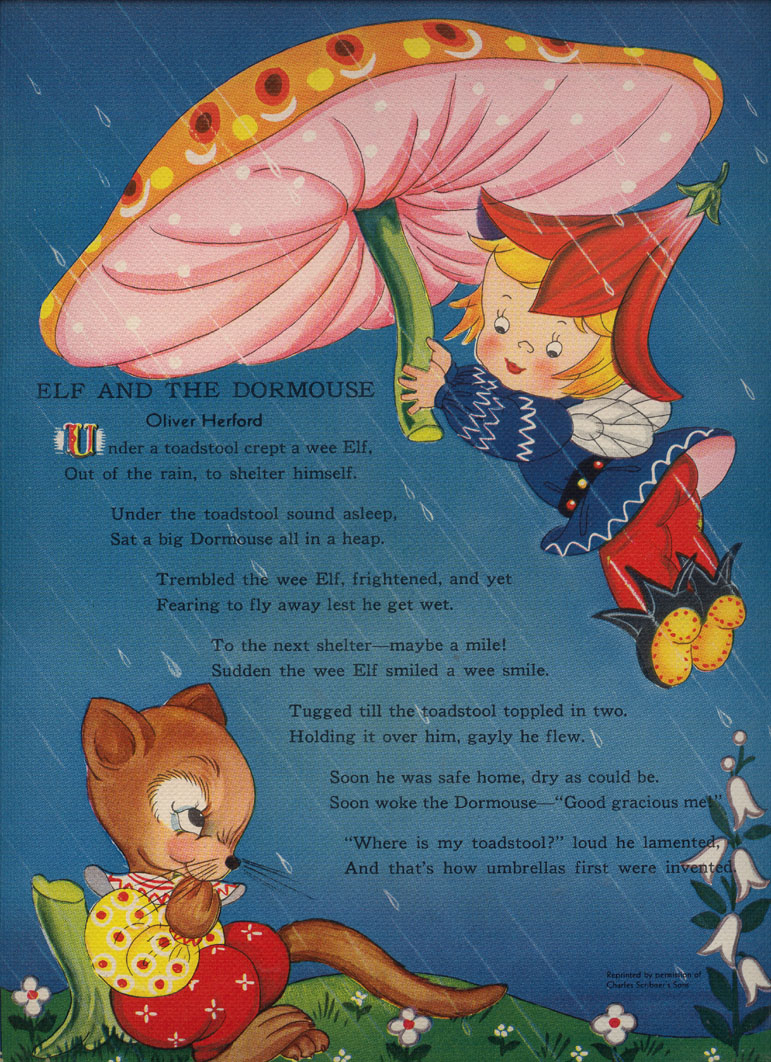
At the event, my brother recited the following poem, Elf and the Dormouse.


I found this cute illustration on Art Side.

It was published in 2012 and gives credit for borrowing it from a 2011 post on Marge8's Blog.

It is slightly hard to read, so here are the words:

'The Elf and the Dormouse'

Under a toadstool crept a wee Elf,
Out of the rain to shelter himself.

Under the toadstool, sound asleep,
Sat a big Dormouse all in a heap.

Trembled the wee Elf, frightened and yet
Fearing to fly away lest he get wet.

To the next shelter—maybe a mile!
Sudden the wee Elf smiled a wee smile.

Tugged till the toadstool toppled in two.
Holding it over him, gaily he flew.

Soon he was safe home, dry as could be.
Soon woke the Dormouse—'Good gracious me!'

'Where is my toadstool?' loud he lamented.
—And that’s how umbrellas first were invented.

Oliver Herford (1863-1935)


My brother was a trooper when he stood on the stage and recited the poem. It went without a hitch until the last line when he said, "Where is my toadstool? loud he lamented. -- And that's how umbrellas first were convented."

Everyone laughed. From the wings, Mrs. Gray whispered: "invented." During the reception afterward, Mrs. Gray told my parents that 'convented' worked much better in the poem. She was considering having future classes say it just like that. For years, at our house, my dad said convented instead of invented if the word came up in conversation.

The next year when Mrs. Gray opened up enrollment for another class, we were given the option to participate or not. I declined, but my brother went for two or three more years. 

Monday, July 23, 2018

Efficiency Expert

My husband's first job as a nuclear engineer was at the Dresden power plant near Morris, Illinois. It was owned and operated by Commonwealth Edison. There were several engineers on site. Many were recent college graduates and newlyweds as well. Since it was nothing unusual for them to stay at work 12 or more hours at a time, they were in the habit of calling their wives a couple of times a day just to check in. In the morning they might call and make sure she was awake and getting ready to go to work or school. In the afternoon, they just called to say hi. There were two phone lines at the plant. One with the local phone company and another direct line to the corporate office in Chicago.

Since this was in 1974, it was at least twenty years before anyone had a cell phone. The calls home to the wives were made on company phones and company time. 

About a year after Commonwealth Edison hired my husband, they retained an efficiency expert to find ways to cut costs within the company.  The man traveled from site to site and studied procedures. At the Dresden power plant, he observed employees making personal phone calls. The engineers were taken to task. 

They informed the guy that marital bliss was maintained through the phone cord. Nevertheless, he told them to cut back. They protested the company was committing telephonus interruptus.

One day my husband answered his desk phone to discover the engineer at the desk next to his was on the line. 

"Bill, why are you calling me? You're sitting right beside me."

Bill laid the receiver down, leaned closer and whispered. "I called your desk long distance on the Chicago line. Their efficiency expert will never figure this one out."

They continued with their work but left the two lines open for an hour or so.

Rule 41: Never tell an engineer he can't do something. 

Monday, July 2, 2018

You Said WHAT to Grandma?

CAUTION: This content is not G-rated.

My brother graduated from college in 1979 with a chemical engineering degree. Then began the job hunt. Without naming any corporations, he interviewed with a firm that manufactured paper products. Our grandmother was anxious to hear about the company and whether he had a chance to land a job. When she learned the primary product was baby diapers, she wasn't as enthusiastic. She couldn't imagine that a large plant would limit themselves to one line and insisted on knowing what else they made.

My brother was as vague as possible and admitted that they did make other stuff. 


What other stuff? Grandma demanded specifics.

Later, my brother said he didn't want to tell her, but she made him.

In the 1970's, if a man didn't want to talk about unmentionable feminine hygiene, he could just say Kotex, and everyone got a pretty good idea what he meant without going into greater detail. There were other brands, but you get the picture.


"They make Kotex, Grandma."
 
Grandma's lips snapped shut, and she dropped the subject. Forever. By the way, he didn't take that job.

Today, kids aren't so reticent about what they say around their grandparents. For instance, last year my son and daughter and their respective spouses played Cards Against Humanity with my mother. If you aren't familiar with that game, I beg you not to look it up.

According to their own press:
Cards Against Humanity is a party game for horrible people. Unlike most of the party games you've played before, Cards Against Humanity is as despicable and awkward as you and your friends.
The game is simple. Each round, one player asks a question from a black card, and everyone else answers with their funniest white card.

Wikipedia says:
Cards Against Humanity is a party game in which players complete fill-in-the-blank statements using words or phrases typically deemed as offensive, risqué or politically incorrect printed on playing cards.

Anyway, these four thirty-somethings convinced my 80-year-old mother to play. Ah-hem. My brother and I played as well.  

Grandma was a good sport. I was offended by how well she embraced the perverted nature of the game. It was just wrong.

I don't know who won. I don't know if we kept score. I think the game is over when someone laughs so hard, they puke.

Monday, June 4, 2018

HOUSE RULES

My Dad's family was crazy for two things: fishing and card games.  The fishing lure (pun intended) skipped a generation with me. I still enjoy a rousing game of 10 point pitch or Aggravation.

I learned to count and add with Dominos. As soon as my brother and I had learned the rudiments of the game with Double Sixes, Dad graduated us to Double Nines. The only indication we ever got from him that we had accidentally played a tile that scored was if he asked if we wanted that count. When we got older, we learned to watch him like a hawk because he would claim he scored when he hadn't or write down 25 points when he had only made 10 or 15.

When we played Aggravation, which was already a fast-paced game, we discovered it would move a lot faster if every player had his own set of dice, instead of waiting for the preceding player to politely pass them on. 🎲🎲🎲🎲🎲🎲🎲🎲

Here are the House Rules for board games.


 Rule One:  Watch Dad.  He Cheats.

Rule Two: Don't let your playing pieces roll off the table.  All other players may move their pieces at warp speed until you get back to the table.  If your playing piece/s roll/bounce into the floor furnace, you are out of the game.

Rule Three: Don't repeat any words Dad said.


A genius invented 10-point pitch. There are an astronomical number of combinations of hands that can be dealt. The human element of players and their bids increase the combinations to an unfathomable level.

House Rules for card games are a little different.

Rule Four: The object of the game is not to win.  The goal is to keep my dad from winning. Period.

Rule Five: If you are in the hole (have a negative score) and shoot the moon (a bid worth 20), and make the bid, you lack 1 point of getting out of the hole. This is a time-honored tradition dating back to the day my grandfather proclaimed the rule when my Dad and my aunt were kids.
Just FYI, going SET means not making your bid. If you bid 7 and fail to get 7 points, you go SET. 7 points are taken off your running score. That's how you can be IN THE HOLE. 


This looks like a good hand. I'm a cautious player. I'd bid 6 in Spades and hope my partner had some trumps. I know people who would bid the maximum 10 on these cards. Why not go crazy and shoot the moon?

Mom and Dad belonged to a card club for about 50 years. They met once a month at alternating homes. In the early years, the host couple gave out prizes for high, low and the Galloper.  If you bid 7 and made it, you wrote your name on the Galloper prize. Whoever had their name on it the most, took it home at the end of the evening. In case of a tie, they drew for high card. Most of the prizes were white elephants, especially low prize. When the lottery was legalized, $2 tickets became popular prizes. 

My folks taught my kids to play pitch when they got big enough to hold the cards. I think my daughter was about twelve before she caught on to what 'going set' meant. We thought it was odd that she didn't react to losing points. One day it hit her that every time she or her partner went set, they lost that many points.  "WHAT!!" she shrieked. After that, when someone lost a hand, my Dad would mimic her.

I told one of my Dad's friends what a low-down cheat he had been when my brother and I were kids.  
"You learned to pay attention to the game, didn't you?" he said.

Monday, May 28, 2018

Uncle Cephas

In my family, oral history has been repeated and handed down for generations. I am attempting to preserve some of the more colorful stories. A favorite is about my great-great uncle Cephas.

Cephas was born in 1884. He was smart, good-looking and somewhat privileged because his parents had worked hard and provided him with more ease and worldly goods than the average homesteader.

At the age of twenty, he married a beautiful woman from Oklahoma. She came from land and money, but Hattie did not take to country life and hated the farm. She bore him two daughters. Neither infant lived more than a few days. Their farm prospered, but the marriage was unhappy. Finally, his wife moved out of their rural home, and Cephas bought her a handsome house in town where she thrived in the company of other women. Nothing made her happier than ladies’ clubs and hosting afternoon get-togethers and card parties. Nothing made her more unhappy than cigars, dirty boots and dogs in the house. Watching him eat off the same fork with his dog disgusted her.

Cephas accumulated more land and developed retail businesses in town. If he got lonely, he visited Hattie. It didn’t take more than a day or two for him to remember why he lived on the farm instead of with his wife.  He couldn’t do anything right and was nagged incessantly about farting and belching in front of her friends. Frankly, he behaved that way on purpose and seemed to delight in annoying her.

Black Gold was discovered under his land, and Hattie demanded he spend the income on her. Perversely, they continued to live apart. She loved to show off the things his money provided her with, and he seemed to enjoy buying the objects. Thus they remained, blissfully separate, for the majority of their married life.

From 1946 through 1949 the nation was bombarded with an ad campaign which changed the thinking of women everywhere. Diamonds were a girl's best friend. Diamonds were forever. Traveling lecturers spoke at high school and college assemblies, brainwashing young women to expect to receive a diamond ring from their sweethearts.
http://www.thefrisky.com/2012-02-09/the-diamond-myth-how-diamonds-became-a-girls-best-friend/

Courtesy of radio and newsprint, Hattie became convinced by the early 1950's that her husband had been remiss in not beautifying her hand. She needed something with some flash to impress her friends. She began her own not so subtle campaign against Cephas. He allowed the cajoling to continue until he agreed to buy her a diamond ring. But there was a condition. Since she had an inheritance from her deceased parents, he thought it only fair that she pay half the price of the ring. Realizing that was the best deal she was going to get, she accepted the stipulation.

St. John boasted a jewelry store, and Cephas casually told her to pick something out and have the owner send him half the bill. Leaving her house, he high-tailed it to the shop and explained the situation to the proprietor, whose business adjoined one of his own.

Cephas instructed his partner in deception to let Hattie pick out any ring she liked. Intimating that she was probably going to hold him up for the most expensive bauble in the store, the owner suggested he show her salesman samples. They were cheap metal and glass representations of costly settings which he would order from Kansas City.

The conversation ended with Cephas saying he didn’t care what ring she chose. The catch was that the owner was to quote her a price exactly twice the actual value. It didn’t take the jeweler two seconds to catch on. They shook hands and slapped each other on the back at the joke they were going to pull on her.

Hattie showed up at the jewelry store the next day and pored over the pieces in the cases. The jeweler used all his skill at flattery to convince her none of the rings did justice to her lovely hand. Slyly retrieving the samples from beneath the counter, he waxed eloquent as he enticed her to imagine the light glittering from a one-carat diamond surrounded by smaller stones. 

Hattie was carried away by the description and didn’t even blink at the price. When informed it would be eight weeks before the ring would grace her finger, she snidely thought her husband could use a couple more months of income to pay for his half of the one of a kind masterpiece. She would also receive the sample. No other customer could order her ring.

The anticipated day arrived, and she imperiously summoned Cephas to town with a reminder to bring his checkbook. When the ring was slipped onto his wife’s finger, he dutifully admired it and complimented her excellent taste. The jeweler pointed out the qualities of the platinum band and elegant setting. He coaxed her to the window where the sunshine did indeed refract light into thousands of glittering facets.

Hattie wrote a check for her half. As Cephas filled out his check, he thanked the owner for helping his wife choose such a lovely ring. He expected her to get years of enjoyment from it. As they happily left the shop, Cephas offered to take her out to a restaurant where she could show it off. Looking over his shoulder as the door swung closed behind them, he saw the proprietor tearing his check into tiny pieces.


Cephas and Hattie discovered the secret to a happy marriage.  Live in separate houses.